

Key Takeaways
A rough idle is a symptom, not a diagnosis. Work from the conditions you can observe, then confirm the fault with tests rather than replacing parts at random.
- Note whether the idle problem appears cold, warm, or all the time.
- Check for vacuum leaks, PCV faults, intake problems, and throttle-body contamination.
- Use misfire data, fuel-pressure tests, and sensor readings to narrow the cause.
- Consider the engine type because diesel, turbocharged, direct-injection, and port-injection engines fail differently.
- Verify the repair with adaptations, a cold start, and a road test.
Identify what is causing the rough idle
A smooth idle depends on consistent combustion and accurate control of air and fuel. When an Audi shakes, hunts for speed, or nearly stalls, the useful clues are when it happens and what changes with temperature or engine load. Begin by recording the symptoms before touching anything. A clear pattern often shortens the diagnosis considerably.
How engine speed, shaking, and stalling point to different faults
Watch the tachometer while the car is stationary, and notice whether the engine speed rises and falls or simply drops too low. A steady shake with a flashing check-engine light often deserves more urgency than a mild fluctuation with no warning light, although neither symptom identifies a single failed part. Note unusual sounds, exhaust odor, hard starting, and whether the problem changes when electrical loads or the air conditioning are switched on.
A useful comparison is the difference between a single-cylinder misfire and an air-control problem. A misfire may feel like a repeated stumble, while an intake leak can produce a high or wandering idle. The rough-idle symptoms described in a general diagnostic guide are a useful reminder that stalling and fluctuating RPMs can have several causes.
Why the problem may occur only when the engine is cold
Cold starts require different fuel and air corrections than a fully warmed engine. A small intake leak, weak ignition component, poor temperature signal, or marginal injector can therefore be most obvious during the first few minutes. If the idle improves as the engine warms, record how long that takes and whether the exhaust smells unusually rich during the warm-up period.
Do not assume that a cold-only symptom is harmless. Repeated misfires can send unburned fuel into the exhaust system, while a leak may become less apparent as rubber softens and fuel corrections change. Compare a cold start after an overnight rest with a restart after a short drive.
How warning lights and stored symptoms improve diagnosis
Scan the vehicle before clearing anything. Stored and pending codes, freeze-frame conditions, and cylinder-specific misfire counts can show whether the fault occurred at cold start, at a particular engine speed, or under a certain load. Even when no code is stored, the absence of a code does not prove that the engine is healthy.
Write down the exact sequence: start, stumble, recovery, warning light, and any change after driving. The symptom pattern matters because a code points toward a system, while the operating conditions help identify the actual cause. If the warning light is flashing, avoid extended driving and arrange professional diagnosis.
When a rough idle signals a serious engine problem
Stop treating the issue as a minor tune-up when there is a flashing warning light, severe shaking, loud mechanical noise, very low oil pressure, overheating, or a strong fuel smell. Hard starting combined with power loss and a camshaft-correlation code can indicate a timing-system fault rather than a simple fuel problem. The documented timing-chain warning signs are a useful example of why starting difficulty and power loss should not be dismissed.
A compression problem, valve fault, or timing error can mimic an ignition or vacuum fault. Continuing to drive while the engine is misfiring may increase catalytic-converter damage and can make the eventual repair more expensive. When symptoms are severe, testing takes priority over parts replacement.
Check the most common air and vacuum issues
Air leaks are among the first things to inspect because they disturb the mixture most noticeably at idle. Start with the intake tract, small hoses, clamps, and connections around the engine rather than assuming the sensor is at fault. Work carefully: a loose hose can create symptoms that look electronic. Photograph hose routing before removing anything.
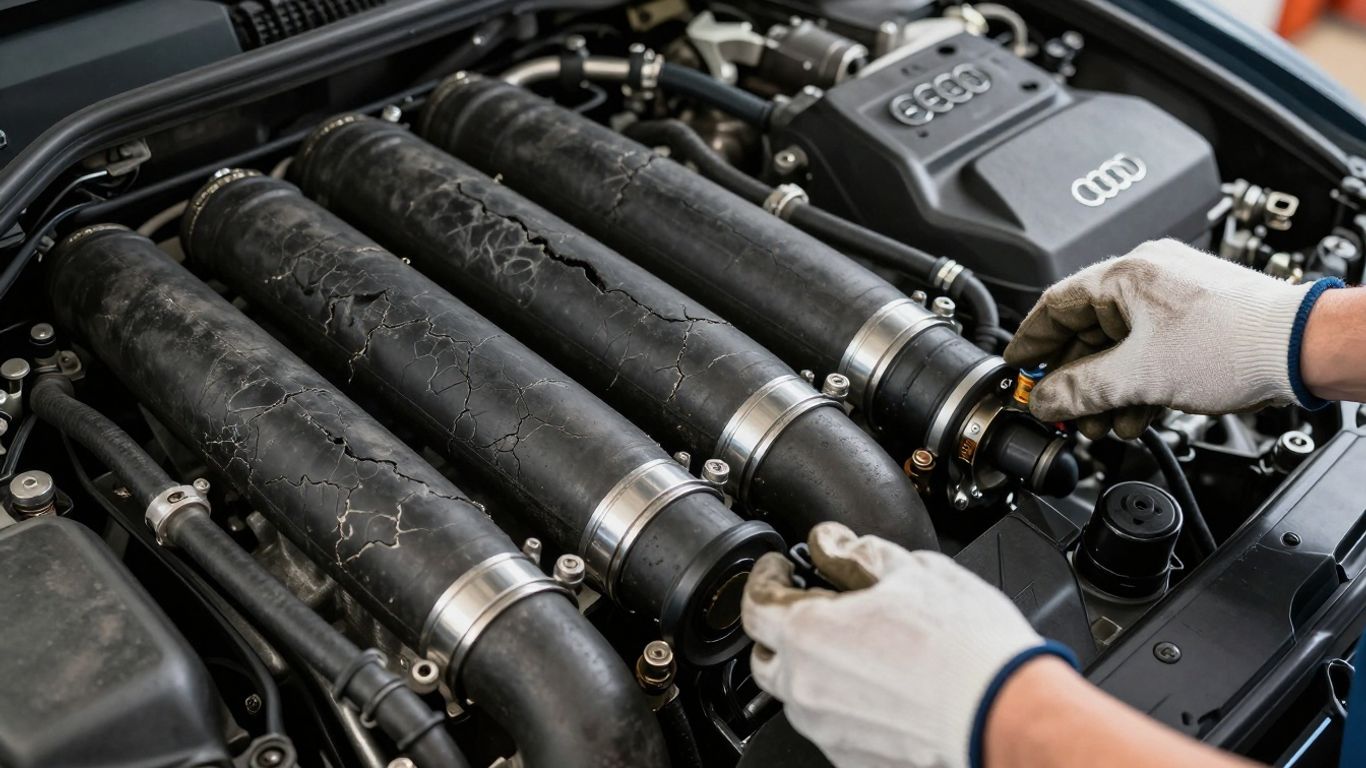
Inspect cracked vacuum hoses and loose intake connections
Look for split rubber, collapsed hoses, loose clamps, and oily marks around a connection. Pay particular attention to small vacuum lines and the hose between the air meter and throttle body, since a crack after the meter allows unmeasured air into the engine. A smoke test is safer and more conclusive than spraying flammable fluid around a running engine.
Repair one leak at a time and recheck the idle. If fuel trims improve after the leak is sealed, that supports the diagnosis, but it does not rule out a second problem. The goal is to confirm the change with scan data rather than relying only on how the engine sounds.
Test the PCV system for leaks or diaphragm failure
The crankcase ventilation system controls pressure inside the engine and connects to the intake. A failed diaphragm or split PCV hose can create a substantial vacuum leak, whistling noise, oil consumption, or an unstable idle. Compare the behavior with the oil filler cap only according to the engine-specific service procedure; unusual suction is a clue, not a complete test.
Inspect the valve, hoses, and surrounding seals for cracks or oil residue. If the system is integrated into a larger cover, replacement may require more care than a simple hose repair. Afterward, check for new leaks and confirm that fuel corrections return toward normal.
Clean and evaluate the throttle body
Deposits around the throttle plate can restrict the small amount of air needed at idle. Remove the intake duct only when the engine is cool and use a cleaner approved for the component, keeping electronics and seals protected. Do not force an electronically controlled plate or scrape its coating.
Cleaning can help when deposits are the cause, but it will not correct a failing actuator, wiring fault, or air leak elsewhere. The throttle may also need an adaptation or relearn afterward. If the idle remains unstable, return to measured data rather than repeating the cleaning.
Check the mass airflow sensor and intake tract
Inspect the sensor connector, air-filter housing, ducting, and seals before condemning the mass airflow sensor. A damaged housing or poorly seated filter can disturb airflow and allow dirt into the intake. Sensor cleaner should be used only when the product and service instructions permit it; touching the sensing element can cause damage.
Compare the reported airflow with engine speed and throttle position, looking for implausible changes rather than chasing one number. A vacuum-leak checklist can help organize this inspection, especially when the engine shakes but no single hose is visibly broken. Always repair the physical intake problem before replacing a sensor.
Diagnose fuel delivery and ignition faults
Once the air path is sound, investigate whether each cylinder receives the correct fuel and spark. A rough idle can come from one weak coil, several worn plugs, inadequate fuel pressure, or an injector that is restricted or leaking. Testing should separate cylinder-specific faults from problems affecting the whole engine. This is where swapping components can be useful, but only when the resulting change is measured.
Test spark plugs, ignition coils, and misfires
Inspect plug condition, gap, deposits, and signs of oil or fuel fouling. A coil swap between cylinders can show whether a misfire follows the coil, but record the original positions and clear only the relevant data after testing. If the misfire stays on the same cylinder, investigate the plug, injector, wiring, compression, and mechanical timing.
Do not continue driving with a severe misfire. A flashing warning light usually means the fault is active enough to threaten the emissions system. A clean-looking plug also does not guarantee good ignition under compression, so scan counters and electrical tests remain valuable.
Check fuel pressure and injector performance
Measure fuel pressure with equipment suitable for the system and compare the result with the correct service specification. Low pressure can result from a pump, regulator, filter, wiring, or control problem, while excessive pressure can create a rich mixture. Injector balance, electrical resistance, and leak-down testing can help identify an individual injector fault.
For diesel versions, rail pressure and metering data deserve particular attention. The Audi A4 diesel idle test illustrates how live readings such as rail pressure, air mass, and injector behavior can be assessed together rather than in isolation. Avoid opening high-pressure diesel fuel connections without the correct procedure and equipment.
Understand how carbon buildup affects combustion
Deposits can restrict airflow, disturb spray patterns, or prevent valves from sealing as they should. Direct-injection gasoline engines may develop intake-valve deposits because fuel does not wash over those valves in the same way as in a port-injection system. EGR and intake deposits can also affect diesel airflow and idle quality.
Before recommending cleaning, confirm the symptom and inspect the relevant components. Borescope inspection, airflow measurements, compression testing, or valve inspection may be more informative than a generic additive. The repair should address the source of the deposits when possible, not only their visible effect.
Compare symptoms of lean and rich running conditions
A lean condition may bring a hunting idle, intake hiss, positive fuel corrections, or improvement when extra fuel is added by the control system. A rich condition may produce fuel odor, dark exhaust, rough starting, negative corrections, or fouled plugs. These are tendencies, not proofs, and sensor errors can make the readings misleading.
Interpret fuel trims with engine temperature, load, and sensor behavior in mind. A lean reading caused by unmetered air calls for an intake inspection, while a rich reading may point toward fuel pressure, injector leakage, temperature information, or inadequate air measurement. Test the system that explains the whole pattern.
Use Audi-specific diagnostic tools and data
Generic code readers can provide a useful starting point, but deeper diagnosis depends on the data available from the vehicle. Read codes before clearing them, save freeze-frame information, and compare live values at cold start and operating temperature. Data is most useful when it changes the next test rather than becoming a list of numbers.

Scan for OBD-II trouble codes and misfire counters
Look for misfire, mixture, throttle, airflow, oxygen-sensor, and camshaft or crankshaft-correlation codes. Misfire counters can reveal a cylinder that has not yet triggered a confirmed fault code, particularly when the engine is allowed to idle long enough for the counter to rise. Record whether counts increase at idle, during acceleration, or under load.
Clear codes only after saving the evidence. A code identifies a detected condition or circuit, not automatically the failed component. For example, a mixture code can result from an air leak, fuel shortage, exhaust leak, or incorrect sensor input.
Read live data from oxygen and air-fuel sensors
Watch sensor response after the engine reaches operating temperature, and compare it with short- and long-term fuel corrections. A slow, fixed, or implausible signal can be significant, but the sensor should not be blamed until wiring, exhaust leaks, intake leaks, and mixture conditions have been checked.
Changes are often more informative than a single snapshot. If fuel correction is high at idle and improves at higher speed, an intake leak becomes more plausible; if it remains high across the range, fuel delivery or airflow measurement deserves closer attention. Use the vehicle’s engine code and service data for exact interpretation.
Check throttle adaptation and idle control values
An electronically controlled throttle may need to relearn its position after cleaning, battery disconnection, or component replacement. Check for adaptation status, fault memory, commanded position, and actual position where the scan tool supports those readings. A mismatch can indicate contamination, actuator wear, wiring trouble, or an adaptation that has not completed.
Follow the specified conditions for the relearn, including battery voltage, ignition state, and coolant temperature. If the procedure fails, do not repeatedly force it; find out whether a fault code or mechanical restriction is preventing completion. Idle control is a system result, not just a throttle setting.
When VCDS or an Audi-compatible scanner is worthwhile
A basic reader may be enough for a simple stored code, but an Audi-compatible scanner becomes more useful when you need manufacturer-level measuring values, adaptation procedures, or detailed misfire information. Choose equipment that supports the functions required by the model rather than assuming every scanner offers the same access.
The scanner is an aid to a physical diagnosis. It cannot seal a cracked hose, measure compression, or replace careful inspection. When the data is unclear, a shop with suitable diagnostic equipment may save time and prevent unnecessary parts purchases.
Match the solution to the Audi engine and model
The same rough-idle complaint can have different causes across Audi engines and model years. Engine code, fuel type, emissions equipment, transmission, and maintenance history all affect the likely fault path. Confirm those details before ordering parts. A model name alone is not enough to select a procedure.
Common rough-idle causes on Audi A4 and A6 models
A4 and A6 vehicles have been sold with multiple gasoline and diesel engines, so there is no universal idle repair. Begin with the basics—air leaks, PCV operation, ignition, fuel pressure, and stored data—then narrow the inspection using the engine code. A diesel may require rail-pressure and EGR checks, while a gasoline engine may point more strongly toward coils, plugs, or intake deposits.
Symptoms that include hard starting and power loss deserve extra caution. Model-specific service information should determine whether timing correlation, compression, or fuel control is tested next. Avoid treating a familiar model complaint as proof of a particular failure.
Diesel-specific issues with EGR, DPF, and intake deposits
Diesel engines can idle poorly when EGR flow is incorrect, the intake is restricted by deposits, or regeneration-related systems are not operating as expected. A DPF problem may bring warning messages, limited power, or changed regeneration behavior rather than an isolated rough idle. Check differential-pressure and temperature information only with the correct tool and specifications.
Do not remove or bypass emissions equipment as a shortcut. If the engine has poor rail pressure control, injector imbalance, or an air-mass disagreement, those faults should be tested directly. A forced regeneration is not a substitute for finding the underlying reason for the symptom.
Turbocharged gasoline engine problems to investigate
Turbocharged gasoline engines add charge-air plumbing, control valves, boost regulation, and additional places for an air leak. Inspect the hose connections and diverter or pressure-control components, but keep the diagnosis focused on what happens at idle. A boost fault that appears only under load may not explain a stationary rough idle.
PCV faults, ignition weakness, and intake-valve deposits can still be relevant. Compare idle behavior with acceleration behavior and use fuel-trim and misfire data to decide whether the issue is air metering, combustion, or boost control. This prevents a turbo-related theory from distracting from a basic vacuum leak.
Differences between direct-injection and port-injection systems
Direct injection places fuel directly in the cylinder, while port injection supplies fuel upstream of the intake valve. That difference affects deposit patterns, injector testing, and the way fuel pressure is measured. Use the correct safety procedure for high-pressure systems, especially when the engine has a separate high-pressure pump.
Port-injection faults may be easier to isolate with conventional pressure and injector tests, but they still require model-specific specifications. In both systems, do not confuse a sensor reading with a confirmed mechanical fault. The strongest diagnosis agrees with symptoms, live data, and a physical test.
Repair, reset, and verify the fix
A repair is not complete when the idle sounds better for thirty seconds. Reassemble the intake carefully, restore electrical connections, perform any required adaptation, and confirm that the original symptom has disappeared under the same conditions in which it first appeared. Keep the old part until the diagnosis is secure. This approach is slower than guessing, but usually cheaper.
Decide which repairs are safe to perform at home
Basic visual inspections, air-filter checks, hose replacement, and some spark-plug or coil work may be reasonable for a capable owner with the correct instructions. High-pressure fuel work, timing components, compression diagnosis, and repairs involving hot exhaust or emissions systems call for professional equipment and experience. If the warning light flashes or the engine is severely unstable, avoid experimenting on the road.
Before starting, gather the engine code, torque specifications, replacement seals, and a way to support or protect connectors. A repair that is technically simple can still fail if a brittle hose or connector is disturbed. When the work involves uncertainty, diagnosis is the safer first step.
Replace damaged components without creating new air leaks
Clean mating surfaces and replace one-time seals, O-rings, or clamps when the procedure calls for them. Route hoses exactly as they were routed, keep them away from heat and moving parts, and confirm that every connector clicks into place. An intake leak created during a PCV or throttle-body repair can look like the original fault.
After reassembly, inspect the entire path from the air filter to the intake manifold. Start the engine and listen for hissing, but do not place hands near belts, fans, or hot components. A smoke test remains the better confirmation when an idle problem continues.
Clear adaptations and complete the required relearn procedure
Use the appropriate scan tool to clear fault memory only after documenting it. Some repairs require throttle adaptation, fuel-trim learning, or another model-specific initialization, while others simply need a normal drive cycle. Follow the stated temperature, voltage, and ignition conditions instead of assuming that disconnecting the battery completes the process.
Resetting values can temporarily hide the evidence of a fault. If the idle becomes smooth and then worsens as the system relearns, inspect for an unresolved air, fuel, or ignition problem. The final result should be supported by live data and a repeatable test.
Confirm the repair with a cold-start and road test
Recreate the original conditions: leave the vehicle long enough for a genuine cold start, monitor the first minutes of idle, and check for warning lights or renewed misfire counts. Then test gentle acceleration, normal cruising, and a stop where the rough idle was previously obvious. Do not perform the road test in traffic until the engine is stable enough to drive safely.
Check for leaks, fluid loss, unusual odors, and loose components after the drive. A successful Audi rough idle solution should address the symptom without creating a new warning or drivability problem. If the fault returns, preserve the new scan data; it may reveal what the first repair changed.
Conclusion
The most reliable Audi rough idle solution is a method, not a single replacement part: observe the pattern, inspect the air path, test ignition and fuel delivery, read meaningful data, and verify the repair under real conditions. That sequence keeps a small hose problem from becoming a needless sensor bill and helps identify the serious faults that should not be driven on.
Frequently Asked Questions
What is the most common cause of a rough idle?
Air leaks, ignition misfires, throttle contamination, fuel-delivery faults, and sensor problems are common possibilities. The actual cause depends on the engine and on whether the symptom appears cold, warm, or under load.
Can a vacuum leak cause an engine to stall?
Yes. Unmetered air can upset the mixture most strongly at idle, where the engine has little airflow margin. A smoke test and fuel-trim readings can help confirm the leak.
Is it safe to drive with a rough idle?
A mild symptom without warning lights may permit a short trip for diagnosis, but a flashing warning light, severe shaking, fuel smell, overheating, or loud mechanical noise calls for stopping and arranging professional help.
Can bad spark plugs cause rough idling?
Worn, fouled, or incorrectly gapped plugs can cause intermittent or persistent misfires. Testing should establish whether the misfire follows a plug or coil before parts are replaced.
Why does the idle improve when the engine warms up?
Temperature changes affect fuel corrections, air control, and component behavior. A small leak or marginal ignition or fuel fault may therefore be most noticeable during cold operation.
Does cleaning the throttle body always fix rough idle?
No. Cleaning can help when deposits restrict airflow, but it will not repair a vacuum leak, failing actuator, wiring issue, injector problem, or mechanical fault. An adaptation may also be required afterward.
When should a mechanic diagnose the problem?
Seek professional diagnosis when the issue is severe, returns after basic inspection, involves high-pressure fuel or timing components, or cannot be explained by scan data and physical tests. Accurate testing is usually less costly than repeated guessing.