

Key Takeaways
A cracked exhaust manifold can begin as a small cold-start noise and develop into a serious exhaust, emissions, or drivability problem. Careful diagnosis matters because a gasket, loose fastener, turbocharger fault, and manifold crack can produce similar symptoms.
- A ticking noise that fades as the engine warms can indicate an exhaust leak.
- Soot, fumes, poor fuel economy, and reduced power are useful clues.
- Heat cycles, overheating, distortion, and unsupported exhaust weight can cause cracks.
- Smoke testing and scan data help separate a manifold fault from related problems.
- Prompt repair reduces the risk of fumes, sensor damage, and further engine stress.
What an Audi exhaust manifold crack means
An exhaust manifold collects hot gases from the engine’s cylinders and directs them toward the rest of the exhaust system. When the casting or a nearby joint fails, those gases escape before they should, often creating noise, heat, and misleading sensor readings. The exact location and size of the leak determine how noticeable the problem becomes.
How the exhaust manifold works
The manifold is bolted to the cylinder head and uses separate runners that merge into an outlet. It must contain extremely hot, fast-moving gases while also coping with vibration and constant expansion and contraction. That combination leaves little room for a damaged mounting surface or a crack to remain harmless indefinitely.
Where cracks commonly develop
Cracks often appear around runner junctions, the outlet flange, thin casting areas, or bolt bosses. They may be difficult to see when the engine is cold because the opening can widen as the metal heats. A mirror, strong light, and inspection from several angles are often more useful than a quick glance from above.
Why turbocharged Audi engines may be more vulnerable
Turbocharged layouts place the manifold and turbocharger close together, exposing connected components to substantial heat. The turbocharger also adds weight and places extra demands on flanges, studs, and supports. This does not mean every turbocharged engine will crack a manifold, but heat management and correct support become especially important.
How a crack differs from a failed gasket or loose fastener
A failed gasket usually leaks along a joint, while a loose fastener may leave a visible gap, damaged stud, or uneven flange mark. A casting crack can run through the manifold itself and may open only at operating temperature. The repair path changes substantially, so replacing a gasket without locating the actual leak can waste time and money.
Symptoms of an Audi exhaust manifold crack
Symptoms can appear separately or arrive as a cluster. A noise on startup, an exhaust smell, and a change in fuel-trim data together are more persuasive than any one sign alone. If you are comparing several possible causes, this exhaust leak guide offers useful background on common crack symptoms and repair concerns.
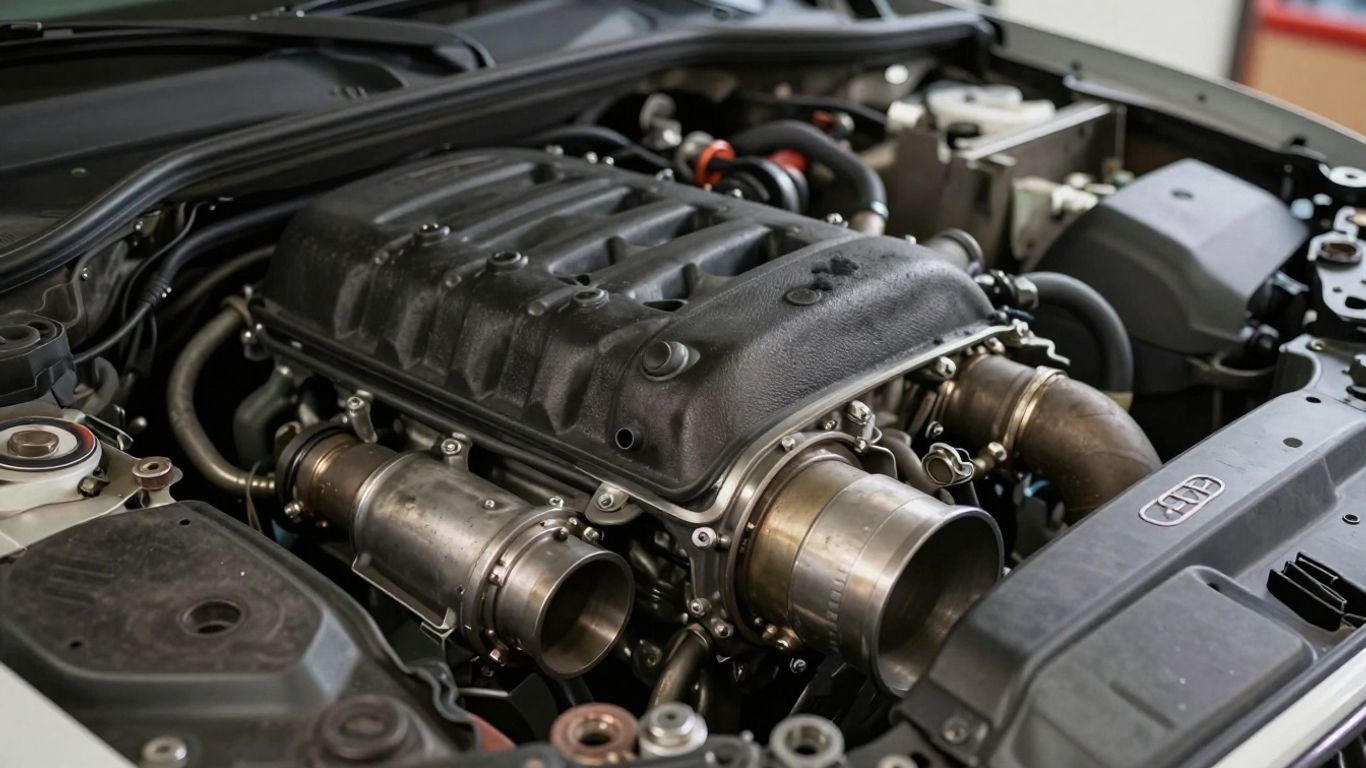
Ticking or tapping noises during cold starts
A small opening often produces a sharp tick or tap while the manifold is cold. As the metal expands, the sound may soften, which can make the issue easy to dismiss. Listen near the rear or front of the engine bay without touching hot components, and compare the noise with engine speed.
Exhaust fumes or fuel smells under the hood
Escaping exhaust can create a sharp, burnt, or fuel-like smell around the engine compartment. The odor may be stronger after a cold start or when the ventilation system draws air from outside. Any exhaust smell inside the cabin deserves immediate attention because carbon monoxide cannot be detected reliably by smell.
Reduced power, boost, or fuel efficiency
A leak before the turbocharger or oxygen sensor can affect how the engine management system interprets exhaust conditions. The result may be weaker response, inconsistent boost, rough running, or increased fuel use. These symptoms are not proof of a cracked manifold, but they make a proper leak test worthwhile.
Check engine light and related fault codes
An exhaust leak can contribute to oxygen-sensor or fuel-trim faults, particularly when outside air reaches the exhaust stream ahead of a sensor. A scan tool may show a lean-related code, but a code alone does not identify the failed component. Read the stored and pending codes alongside fuel trims, freeze-frame data, and a physical inspection.
Visible soot around the manifold
Dry black soot around a flange, runner, shield, or nearby pipe is a strong visual clue that exhaust has been escaping. Heat discoloration, damaged insulation, or melted wiring can also show where the leak has been traveling. Clean-looking metal does not rule out a crack, especially when it opens only under heat and pressure.
Common causes of a cracked Audi exhaust manifold
Most manifold failures develop from a combination of heat, movement, and load rather than from one isolated event. The material repeatedly expands and contracts, while fasteners and supports must keep the assembly aligned. Understanding the cause helps prevent a replacement part from suffering the same failure.
Repeated heat cycles and thermal stress
Every drive warms the manifold and every shutdown allows it to cool. Over many cycles, that movement can fatigue cast metal, especially around sharp corners, welds, and thick-to-thin transitions. Short trips, heavy loads, and frequent high-temperature operation can increase the number and severity of these stresses.
Warped components and uneven bolt tension
A flange that is no longer flat cannot seal evenly, even with a new gasket. Incorrect torque, corrosion, or a stretched fastener can concentrate force in one part of the manifold. The resulting distortion may produce both a leak and a crack, so the mating surfaces should be checked rather than simply tightened.
Engine movement and mounting problems
Worn engine mounts allow more movement during acceleration and gear changes. Failed exhaust brackets or supports can also transfer weight and vibration into the manifold. Before fitting a replacement, inspect the mounts and the exhaust assembly so the new part is not forced to carry loads it was never designed to handle.
Poor-quality replacement parts or previous repairs
A replacement with thin sections, poor fitment, or unsuitable material may not tolerate the same operating conditions as the original. Previous welding can also leave hard spots or distortion if the repair was not prepared and finished correctly. A low purchase price can become expensive when removal and access work have to be repeated.
Overheating and abnormal combustion
An overheating engine exposes the manifold and nearby components to temperatures beyond their normal range. Misfires, incorrect fueling, or other combustion problems can add heat to the exhaust stream as well. Correcting the underlying engine fault is part of the repair, not an optional follow-up task.
How to diagnose the problem accurately
Diagnosis should begin with a cold engine and proceed methodically. The aim is to identify the leak’s starting point, determine whether it affects sensor readings, and rule out nearby components that can mimic the same symptoms. Avoid probing or loosening parts while they are hot, and keep hands and clothing clear of moving belts and fans.
Inspecting the manifold and surrounding components
Start with the manifold, gasket lines, studs, heat shields, turbocharger connections, and nearby wiring. Look for soot trails, hairline fractures, missing hardware, and contact marks caused by movement. A cold-start observation can be especially helpful because the leak may be loudest before thermal expansion closes the gap slightly.
Using smoke testing to locate exhaust leaks
A low-pressure smoke test can reveal escaping smoke around a crack or flange without relying on sound alone. The system must be tested in a controlled way, with suitable equipment and attention to components that could be damaged by pressure. Once smoke appears, inspect the exact origin rather than assuming the nearest visible stain is the source.
Checking oxygen sensor and fuel-trim data
Scan data can show whether the engine computer is compensating for a mixture that appears too lean or otherwise abnormal. Compare short-term and long-term fuel trims with the engine temperature, operating condition, and location of the suspected leak. This lean-code explanation describes why an upstream exhaust leak can influence oxygen-sensor readings, although other faults can create similar codes.
A compact diagnostic sequence helps keep the inspection focused:
- Listen and inspect during a cold start.
- Check flanges, runners, studs, shields, and supports for soot or movement.
- Perform a suitable smoke or leak test.
- Scan codes and compare fuel-trim data.
After these steps, confirm the repair location before ordering parts. A code or noise can point toward the exhaust system, but it cannot by itself prove that the manifold casting is cracked.
Distinguishing manifold damage from turbocharger issues
Turbocharger faults may also cause noise, low boost, smoke, or reduced power. A manifold crack is more likely to leave soot at a flange or runner and produce a sharp exhaust tick, while turbocharger problems may involve shaft play, oil contamination, or compressor-side symptoms. Testing both areas prevents an expensive part from being replaced on assumption.
When professional diagnostic equipment is necessary
Professional help is sensible when access is limited, the crack is hidden behind shields, or several fault codes appear together. A repair facility may have a smoke machine, scan equipment with live data, borescopes, and safe lifting equipment. Complex turbocharged layouts can make a seemingly simple inspection difficult without the right tools.
Risks of driving with a cracked exhaust manifold
A small leak can remain drivable for a short distance, but that does not make it safe to ignore. Hot gases can damage nearby parts, and incorrect sensor information can change how the engine runs. The risk increases when fumes enter the cabin, the engine is losing power, or the crack is close to wiring and heat-sensitive components.
Carbon monoxide entering the passenger compartment
Exhaust gases can travel through gaps in the engine bay, ventilation intake, or body seals. Carbon monoxide is particularly dangerous because it is colorless and odorless, and symptoms such as headache, dizziness, or nausea can develop before occupants understand the cause. Stop driving and move to fresh air if fumes are noticed inside the vehicle.
Damage to oxygen sensors and catalytic converters
A leak ahead of an oxygen sensor can expose the exhaust stream to outside air and distort readings. The engine may then adjust fueling incorrectly, while unburned fuel or excess heat can place additional stress on emissions components. Continued driving can turn a manifold repair into a broader exhaust-system repair.
Incorrect air-fuel readings and engine performance problems
False oxygen readings may cause the control system to add or remove fuel when the engine does not actually need that correction. That can produce rough running, poor economy, hesitation, or recurring warning lights. The symptoms may persist until the leak and any resulting engine-management issue are both addressed.
Increased turbocharger stress
On a turbocharged engine, an exhaust leak before the turbine can reduce the energy reaching it and disturb expected boost behavior. The system may work harder to meet its target, depending on the fault and control strategy. Persistent heat and pressure problems should therefore be investigated before they affect the turbocharger or its connections.
Situations that require immediate repairs
Do not continue driving if fumes enter the cabin, the check engine light flashes, the engine overheats, or power drops sharply. A loud leak near wiring, fuel components, or plastic parts also deserves prompt attention. Towing may be safer than attempting a long trip to a workshop.
Audi exhaust manifold repair and replacement options
The correct repair depends on the material, crack location, accessibility, and condition of the mounting surfaces. A sound diagnosis should come before a decision between welding and replacement. Parts availability and access can vary by engine layout, so a repair estimate should include more than the manifold itself.
When welding can provide a temporary or lasting repair
Welding may be practical when the crack is accessible, the surrounding metal is sound, and the component can be removed and prepared properly. Some repairs last, while others fail again because thermal expansion continues to stress the area. A technician should inspect for distortion and fatigue rather than treating every visible crack as a simple patch.
When replacing the manifold is the better choice
Replacement is usually more sensible when the casting is badly fractured, warped, thin around the repair, or damaged in several places. It can also be preferable when a previous weld has already failed. Compare the condition of the manifold with the cost of removal, preparation, and repeat labor before choosing the cheapest-looking option.
Inspecting studs, gaskets, and mounting surfaces
A new manifold will not seal correctly against a damaged flange or bent cylinder-head surface. Replace unsuitable gaskets, inspect studs for stretching or corrosion, and verify that heat shields and supports are secure. Fasteners should be tightened in the specified sequence and to the correct torque, not simply made as tight as possible.
Choosing original-equipment or aftermarket components
The important questions are fit, material, flange accuracy, heat resistance, and parts support. An aftermarket component can be suitable when its construction and application are well documented, while an original-equipment part may simplify fitment in a difficult installation. Confirm the exact engine and turbocharger configuration before ordering.
Typical labor, parts, and access considerations
The manifold itself may not be the largest cost. Seized studs, restricted access, heat shields, turbocharger removal, broken fasteners, and cleaning the mating surface can add substantial labor. Ask whether the estimate includes new gaskets and hardware, inspection of supports, and checks for the cause of the original failure.
Preventing future exhaust manifold cracks
Prevention comes down to controlling heat, maintaining support, and avoiding installation errors. A replacement manifold should be treated as part of a system rather than an isolated component. Small cooling or mounting problems are much cheaper to address before they create another leak.
Following Audi cooling-system maintenance schedules
Keep coolant level, hoses, the thermostat, radiator, fans, and water pump in good condition according to the vehicle’s maintenance needs. A cooling-system fault can raise under-hood and exhaust temperatures beyond normal limits. Never dismiss repeated coolant loss or temperature changes as unrelated to an exhaust-manifold failure.
Addressing overheating and misfires promptly
Overheating and misfires can place abnormal heat into the exhaust system. Warning lights, rough running, coolant loss, or a temperature gauge that moves beyond its usual position should be investigated promptly. Repairing these conditions protects the replacement manifold as well as the engine and catalytic converter.
Using correct torque specifications
Use the specified torque values, tightening order, and fastener condition for the particular engine. Uneven clamping can distort a flange or leave a gasket lightly sealed on one side. Recheck accessible hardware during service only when the procedure calls for it; indiscriminate retightening can create its own problems.
Inspecting mounts and exhaust supports
Check engine mounts, brackets, hangers, flex sections, and shields for sagging, contact, or cracked rubber. A supported exhaust system places less strain on the manifold and its fasteners. Replacing only the cracked casting while leaving a failed hanger in place invites another failure.
Checking repairs during routine servicing
After repair, look for fresh soot, unusual ticking, heat damage, and returning fault codes during routine inspections. A cold-start listen can reveal a small leak before it becomes obvious on the road. Keeping notes about the repair and the parts used also makes future diagnosis faster.
Conclusion
An Audi exhaust manifold crack should be approached as both a leak and a possible symptom of excessive heat, distortion, or unsupported movement. Early inspection, accurate testing, and a repair that addresses the surrounding hardware can protect the engine, emissions components, and people in the cabin. When fumes, overheating, or major power loss appear, stop driving and arrange a professional assessment.
Frequently Asked Questions
Can a cracked exhaust manifold cause a ticking noise?
Yes. Escaping exhaust often creates a sharp ticking or tapping sound, especially during a cold start when the crack is open and the metal has not yet expanded.
Can an exhaust manifold crack trigger the check engine light?
It can, particularly when the leak is near an oxygen sensor and changes the readings used for fuel control. A warning light can also come from another fault, so scan data and physical testing are needed.
Is it safe to drive with a cracked exhaust manifold?
Short trips may be possible in minor cases, but driving is not advisable when fumes, overheating, flashing warnings, severe noise, or significant power loss are present. Carbon monoxide exposure makes cabin fumes an urgent concern.
Can a manifold crack be welded?
Some cracks can be welded after the part is removed, cleaned, and assessed. Welding is less suitable when the metal is distorted, fatigued, or cracked in several locations, and the repair may not prevent future thermal-stress failure.
How can I tell a cracked manifold from a bad gasket?
A gasket leak usually follows a joint or flange, while a manifold crack may run through the casting or runner. Soot patterns, smoke testing, and inspection with the engine cold and warm help distinguish them.
What causes exhaust manifold cracks?
Common contributors include repeated heat cycles, overheating, uneven fastener tension, warped flanges, engine movement, failed exhaust supports, poor repairs, and abnormal combustion temperatures.
Should the oxygen sensors be replaced after a manifold crack?
Not automatically. Sensors should be tested for contamination, damage, and plausibility after the leak is repaired. Replacement is appropriate only when testing shows that a sensor has been harmed or is no longer operating correctly.