

Key Takeaways
Audi alternator problems can begin with a warning light or flickering lamp and end with a stalled vehicle. Testing the complete charging system is more reliable than replacing the battery by guesswork.
- The alternator charges the battery and supplies electrical power while the engine runs.
- Warning lights, dimming lamps, slow cranking, and strange noises can point to charging trouble.
- A voltage test should be supported by inspections of the belt, wiring, grounds, and battery.
- Start-stop systems and energy-management settings can affect diagnosis and replacement.
- Driving with a battery warning light should be limited because the vehicle may soon lose electrical power.
What an Audi alternator does and why it fails
An alternator converts the engine’s mechanical energy into electrical energy for the vehicle’s systems. It also replenishes the battery after starting, so a fault can eventually affect starting, lighting, climate control, and electronic modules. The exact arrangement varies by engine and model year, which is why the vehicle’s service information matters.
How the alternator powers the electrical system
The alternator produces electrical current as its pulley spins, and the vehicle’s charging circuit distributes that current to the battery and electrical loads. At idle or under heavy demand, output may change as the control system manages available power. A problem can therefore appear as an intermittent symptom before the alternator stops producing useful output altogether.
The alternator does not operate in isolation. A healthy result depends on the battery, drive belt, cables, grounds, fuses, and control signals all working together. That is why Audi electrical symptoms are best treated as clues rather than proof of one failed part.
The role of the battery, serpentine belt, and voltage regulator
The battery supplies the high current needed for starting and provides reserve power when demand briefly exceeds alternator output. The serpentine belt transfers engine rotation to the alternator, while the voltage regulator helps control charging voltage. A weak belt tensioner, slipping belt, poor connection, or regulator fault can imitate a worn alternator.
A battery may also be discharged by repeated short trips without being the original cause. Conversely, a failing alternator can leave a previously healthy battery unable to recover. Testing the whole circuit prevents those two problems from being confused.
Common causes of alternator failure in Audi models
Internal bearings, brushes, diodes, windings, or regulation components can wear with age and heat. External causes include belt failure, contaminated connectors, corroded terminals, poor grounds, and fluid reaching the alternator. High electrical demand does not automatically cause failure, but it can expose a marginal charging system sooner.
The engine designation can help identify the right service information and replacement part. A useful Audi engine badge guide explains terms such as TFSI, TDI, e-tron, and quattro, although charging-system testing still needs to follow the specific vehicle.
How driving conditions and electrical modifications affect alternator life
Frequent short journeys, heavy traffic, high temperatures, and long periods of idling can leave the battery undercharged and place repeated demands on the charging system. Added lighting, audio equipment, chargers, or other accessories may increase the load beyond the original configuration. Poorly installed modifications can also introduce resistance or parasitic drain.
Keep accessories correctly fused and inspect added wiring for loose connections. If a vehicle is used mostly for short trips, periodic battery testing can reveal declining reserve capacity before it becomes a starting problem.
The most common Audi alternator problems and symptoms
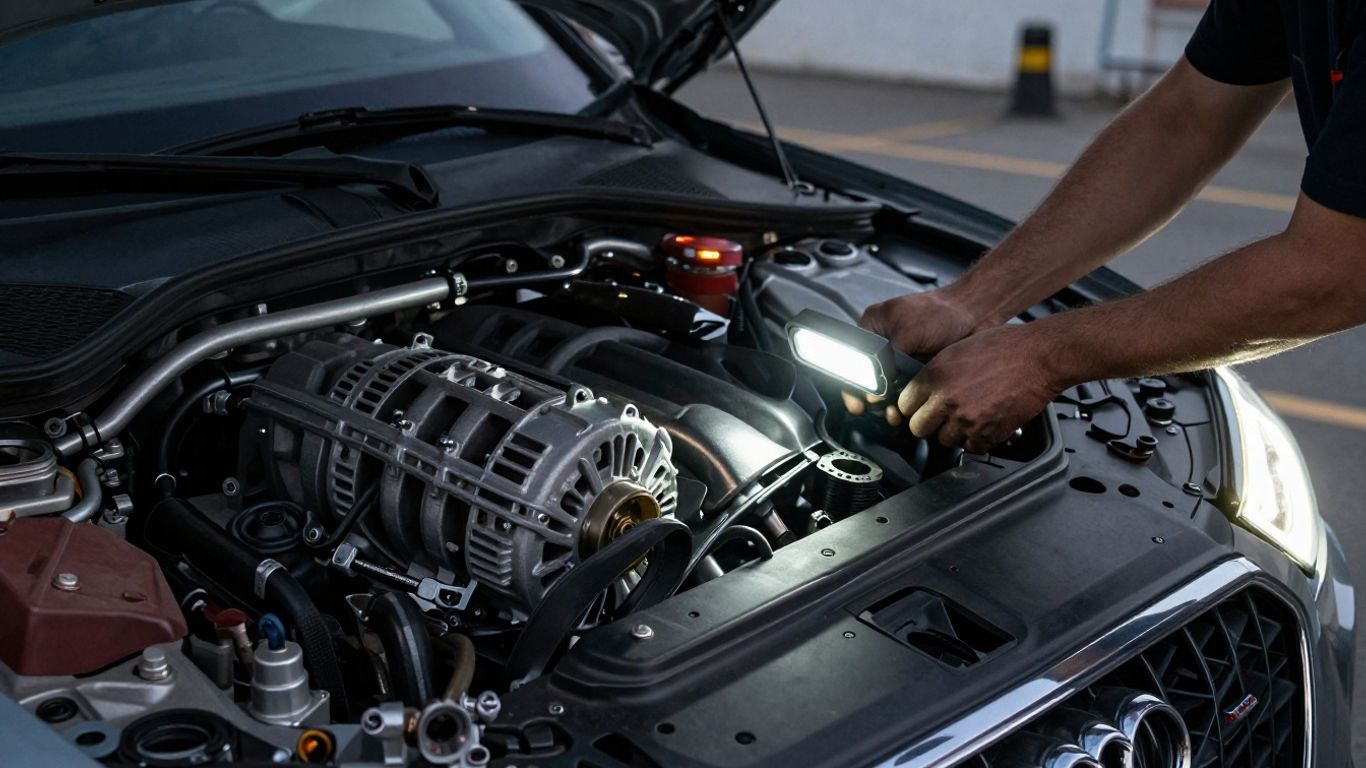
Audi alternator problems often develop through several small signs rather than one dramatic failure. A battery-shaped warning light deserves attention, but so do changes in lamp brightness, starting speed, accessory behavior, or belt noise. The symptoms below can overlap with battery, wiring, and belt faults, so they should lead to testing rather than an immediate parts order.
Battery warning light and dashboard alerts
A battery warning light generally indicates a charging-system concern, not necessarily a battery that is simply old. It may appear steadily, flicker, or arrive with other electrical warnings as system voltage changes. A scan of the vehicle and a physical charging test can help determine whether the alternator, wiring, battery, or control circuit is responsible.
Do not dismiss the light because the engine still starts. The battery may be supplying the vehicle temporarily while the alternator contributes little or no charge. More alternator warning-light symptoms can help put a dashboard alert alongside other observable signs.
Dimming, flickering, or unusually bright lights
Headlights, interior lamps, and dashboard illumination may dim at idle or flicker when electrical demand changes. Unusually bright lights can suggest unstable regulation rather than strong charging. The pattern matters: a quick change with engine speed, load, or steering input can help a technician reproduce the fault.
Record when the change occurs and which accessories are operating. That simple detail can distinguish a steady low-output problem from an intermittent connection or belt issue.
Slow starting, clicking, or repeated battery drain
A slow crank or clicking starter often means the battery lacks enough available power. The alternator may be involved if it failed to recharge the battery on earlier trips, but a weak battery or poor terminal connection can create the same experience. Repeated jump-starts solve the immediate symptom without identifying the cause.
A slow-cranking engine checklist can help organize observations before an appointment. If the battery goes flat again after a full charge, the charging circuit and any parasitic drain should be tested together.
Electrical accessories that work intermittently
Power windows, climate controls, audio equipment, instrument displays, and other accessories may behave unpredictably when system voltage is unstable. One accessory failing alone may indicate its own fuse, switch, or motor, while several unrelated systems acting up at once points more strongly toward shared power or ground problems.
Make a note of whether the issue occurs at idle, during acceleration, after rain, or when headlights and climate control are on. Intermittent faults are easier to reproduce when the conditions are recorded.
Burning smells, whining noises, or belt-related sounds
A hot electrical smell may come from an overloaded component, damaged wiring, or a slipping belt. Whining, grinding, or growling can arise from alternator bearings, pulley components, or another accessory driven by the same belt. A squeal on startup may be belt-related rather than an internal alternator failure.
Stop and inspect safely if smoke, severe noise, or a rapidly worsening smell appears. A bad alternator symptom guide offers a broader comparison, but a noise from the belt drive should be checked in person rather than diagnosed from sound alone.
How to diagnose Audi alternator problems
Diagnosis begins with measurements and inspection, not with the warning light alone. A technician should compare battery condition, charging output, belt drive, wiring, grounds, and stored fault information. Since Audi alternator problems can resemble a bad battery, a sequence of checks reduces unnecessary replacement.
Checking battery voltage with the engine off
With the engine off and the vehicle rested, a technician can measure battery voltage and assess whether the battery is charged enough for further testing. The reading is only one part of the picture: surface charge, temperature, battery age, and internal condition can affect it. A load or conductance test may be needed to judge starting ability.
The test should be performed at the battery terminals and compared with the vehicle’s condition. Corroded clamps or a loose terminal can make a good battery appear unreliable.
Testing charging voltage while the engine is running
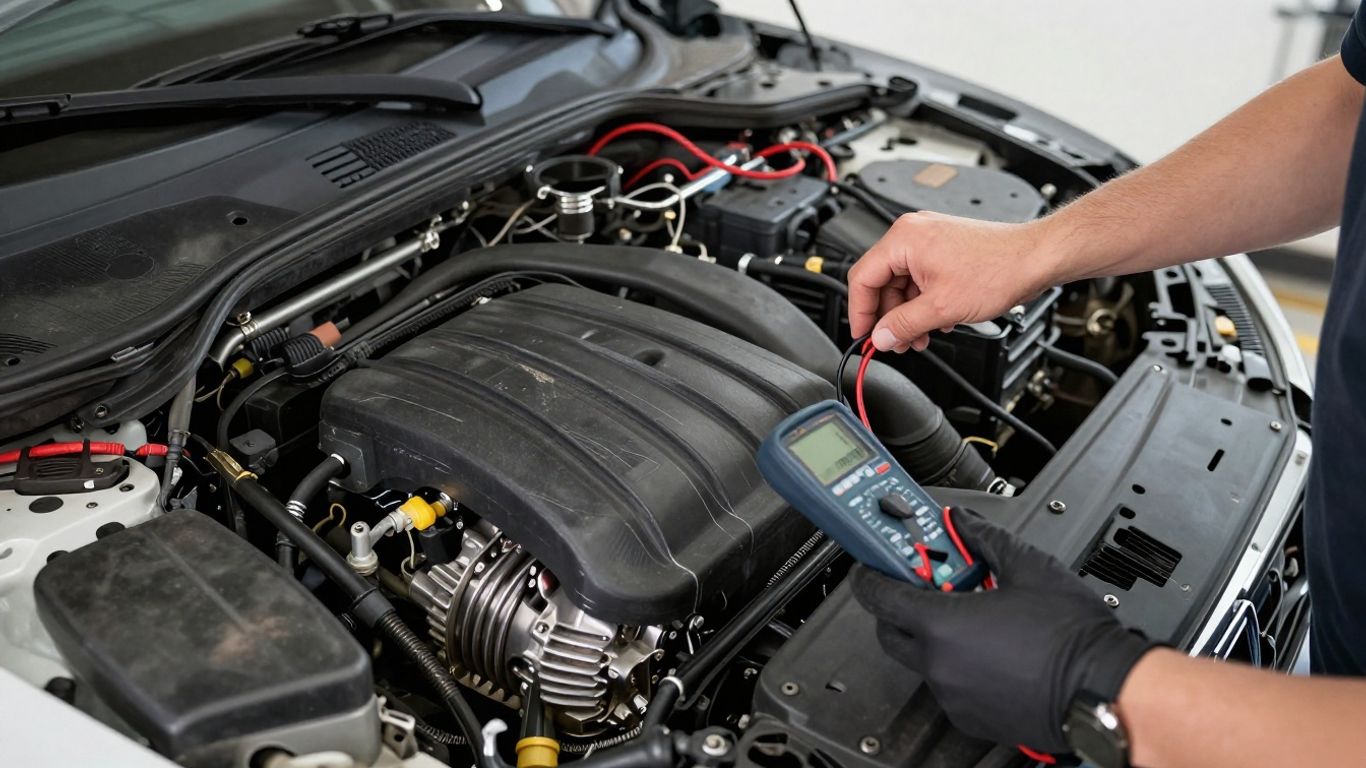
With the engine running, charging voltage should be checked at idle and under controlled electrical loads. The result should remain appropriate for the vehicle’s charging strategy rather than being judged by one universal number. Excessively low, high, or unstable readings require further testing.
A technician may compare alternator output, battery-terminal voltage, and voltage drop across the positive and ground sides. Those comparisons can reveal resistance in a cable even when the alternator itself is functioning.
Inspecting the alternator belt, wiring, and connections
The belt should be checked for cracking, glazing, contamination, slack, and alignment, while the tensioner and pulley should move correctly. Wiring inspections should include the alternator connector, main cable, battery terminals, grounds, and relevant fuses. Heat damage or fluid contamination near a connector deserves attention.
A compact inspection sequence keeps the diagnosis orderly:
- Check belt condition, alignment, tension, and pulley movement.
- Inspect battery terminals, grounds, and alternator connections.
- Measure voltage drop across the positive and ground paths.
- Look for fluid contamination, damaged insulation, or blown fuses.
These checks help separate a failed alternator from a charging circuit that cannot deliver its output. They also reduce the chance of fitting a replacement unit into the same underlying fault.
Using diagnostic trouble codes and scan tools
A scan tool can show charging-related codes, energy-management information, and communication faults stored by vehicle modules. Codes are evidence of what the control system observed, not a complete diagnosis. They should be interpreted alongside live data, voltage measurements, and a physical inspection.
Some faults appear only under load or during a particular operating condition. Clearing a code without correcting its cause may simply allow it to return.
Distinguishing alternator failure from a bad battery
A weak battery can fail a starting test even when the alternator is healthy. An alternator can also test poorly because a belt is slipping, a cable has high resistance, or a fuse or ground is compromised. Testing both components after the vehicle has been driven is often more informative than testing either one in isolation.
The sequence should include battery condition, resting voltage, cranking performance, charging output, and voltage drop. That evidence supports a repair decision instead of treating every dead battery as proof of alternator failure.
Audi-specific causes of charging-system failure
Modern charging systems may vary output according to battery condition, electrical demand, temperature, and driving conditions. Model year, engine, battery type, and equipment can change the correct diagnostic procedure. The safest approach is to verify the vehicle configuration before replacing a component or changing energy-management settings.
Effects of start-stop systems and smart charging
Start-stop vehicles may restart the engine frequently and use charging strategies designed around fuel efficiency and battery state. The alternator may not maintain one fixed output in every condition. A reading taken without considering operating state can therefore be misleading.
Technicians should confirm the vehicle’s charging strategy and test it under suitable conditions. Start-stop operation also makes battery condition especially relevant because the battery may be asked to support more engine restarts.
Battery registration and energy-management requirements
Some vehicles require battery replacement information to be entered into the energy-management system so charging behavior matches the new battery. The exact requirement depends on the model, battery technology, and vehicle equipment. Incorrect information can contribute to poor battery life or charging behavior.
Before installation, confirm whether registration, adaptation, or coding is specified for that vehicle. The procedure should follow reliable service data rather than a generic assumption applied to every model.
Wiring, ground, and fuse problems
A charging complaint may originate in a cable, ground strap, connector, or fuse rather than inside the alternator. Resistance in the path can reduce the voltage reaching the battery even when the alternator produces output at its own terminal. Water intrusion and corrosion can make these faults intermittent.
Voltage-drop testing under load is particularly useful here. Tightening a visible terminal without checking the complete path may leave the real restriction untouched.
Oil or coolant leaks near the alternator
Fluid contamination can damage insulation, bearings, connectors, or the belt drive. An alternator that repeatedly fails after replacement may be receiving contamination from a leak above or nearby. The leak should be located and corrected before a new unit is installed.
Cleaning the outside of a component does not repair internal damage. A technician should inspect the source, surrounding harnesses, and belt condition as part of the repair plan.
Differences between older and newer Audi electrical systems
Older vehicles may use simpler charging controls, while newer vehicles can integrate the alternator with battery monitoring, network communication, and energy-management functions. That does not mean every newer fault requires a module replacement, but it does mean a basic voltage reading may not tell the whole story.
The vehicle identification number, battery type, engine, and equipment list help establish the correct procedure. Parts should be matched to that configuration rather than selected only by appearance.
How serious are Audi alternator problems?
The seriousness depends on the remaining battery charge, the cause of the fault, and whether the belt drive is intact. A vehicle may continue for a short time after the warning light appears, but the available reserve is unpredictable. Planning a prompt inspection is safer than waiting for a complete loss of power.
When it is safe to drive briefly
A short drive to a nearby repair facility may be reasonable if the vehicle starts normally, the warning is recent, no belt noise or burning smell is present, and essential systems continue working. Turn off nonessential loads and avoid stopping the engine unnecessarily. This is a limited exception, not a guarantee of safe travel.
Choose a direct route and tell someone where you are going. If the symptoms worsen, stop in a safe location rather than trying to complete the trip.
Situations that require immediate roadside assistance
Arrange roadside assistance when the battery light is accompanied by smoke, severe belt noise, repeated stalling, overheating, or multiple rapidly changing electrical warnings. A vehicle that barely starts or loses headlights and instruments should not be driven in traffic. A broken belt may also affect other engine-driven components depending on the configuration.
The safest response is to switch off the engine when appropriate and have the vehicle transported for diagnosis. Continuing to drive can turn a manageable charging repair into a broader roadside failure.
How alternator failure can damage or disable other systems
Low or unstable voltage can interrupt modules, reset displays, disable accessories, and create a collection of misleading fault codes. A charging problem may not directly damage every affected component, but repeated voltage instability makes diagnosis harder and can leave important systems unavailable. Overvoltage is a separate concern that may harm sensitive electronics.
This is why the battery, alternator, wiring, and control system should be evaluated as one circuit. Replacing unrelated modules before stabilizing system voltage can waste time and money.
Risks of continuing to drive with a battery warning light
If the alternator is not charging, the vehicle is gradually using stored battery energy. Once that reserve is exhausted, the engine may stop and electrical assistance may be lost. The stopping point depends on battery condition, electrical load, temperature, and the original fault.
Treat the warning as a request for prompt testing. A battery-light diagnosis guide can help with initial observations, but it cannot replace a vehicle-specific inspection.
Repair and replacement options for an Audi alternator
Repair should begin with a confirmed cause and a clear assessment of the surrounding charging circuit. In some cases the alternator is serviceable; in others, replacement is more sensible because internal wear is extensive or a reliable unit is readily available. The best option balances fit, quality, warranty, labor, and the condition of related parts.
When a faulty alternator can be repaired
A specialist may repair an alternator by replacing selected internal components such as bearings, brushes, or a regulator when the housing, windings, and other parts remain sound. Repair is less attractive when contamination, heat damage, or multiple internal failures are present. The unit should be tested after rebuilding, not simply cleaned and returned.
The repair decision should also consider labor access. Saving on the part may not help if a low-quality rebuild fails soon after installation and the labor must be repeated.
Choosing between a new, remanufactured, and used unit
A new unit normally offers predictable condition but may cost more. A remanufactured unit can be a practical middle choice when it has documented testing and a useful warranty. A used unit may suit a budget repair, but its remaining service life is harder to know.
Match the unit by application, output rating, connector, pulley arrangement, mounting points, and battery-management requirements. A part that physically fits is not automatically electrically correct.
What to inspect or replace during installation
Installation is an opportunity to inspect the belt, tensioner, pulley, battery terminals, grounds, fuses, and nearby wiring. Fluid leaks should be repaired before the replacement is fitted. The battery may need charging or testing because an old undercharged battery can place extra demand on the new alternator.
Use the correct torque and routing information, then verify belt alignment and charging output. A clean installation prevents a repeat failure caused by a neglected surrounding component.
Estimating parts and labor costs
Cost varies with model, engine access, alternator type, labor time, diagnostic work, and whether related parts are needed. A quote should separate diagnosis, parts, labor, belt or tensioner work, battery service, and any programming or registration. Asking for the unit’s warranty and test coverage is also sensible.
A lower initial price may not be the lower total cost if the part has uncertain history or the original fault remains. Compare complete repair plans rather than alternator prices alone.
Resetting, coding, or registering related components after repair
Some vehicles may require battery registration, adaptation, or other service procedures after charging-system work. The requirement depends on the specific vehicle and the component replaced. The technician should confirm the procedure using the vehicle identification and service information.
After repair, verify charging behavior, warning-light status, stored codes, belt operation, and starting performance. Keep the test results with the invoice so future diagnosis has a useful baseline.
How to prevent future Audi alternator problems
Prevention is mostly careful maintenance and early response to small changes. The charging system should be considered during battery service, belt inspections, and routine electrical diagnosis. Regular checks are especially useful for vehicles used in heavy traffic, extreme temperatures, or frequent short trips.
Maintaining the battery and charging system
Keep the battery fully charged when appropriate, clean its terminals, and test its condition before winter or extended periods of low use. A battery that repeatedly needs a jump-start deserves diagnosis rather than continued reliance on portable boosters. Charging-system output should be checked when battery performance changes.
Use the correct battery type and follow any model-specific registration procedure. Good battery maintenance reduces unnecessary strain without masking an alternator fault.
Inspecting belts, terminals, and grounds during service
A visual inspection can identify belt cracking, contamination, loose terminals, corrosion, and damaged ground straps before they create a no-start event. Connections should be clean and secure, while the belt should track correctly through its pulleys. Any fluid leak near the charging system should be investigated.
Keep a record of recurring symptoms and repairs. It helps reveal whether a fault is isolated or returning because an underlying connection, leak, or belt problem was missed.
Reducing unnecessary electrical loads
Turn off accessories that are not needed when the engine is idling, and avoid poorly installed electrical equipment. Added devices should have appropriate wiring, fusing, and secure grounds. This is particularly useful when the vehicle makes frequent short journeys or spends long periods in traffic.
Electrical restraint cannot fix a failing alternator, but it can reduce the load while you arrange testing. It also makes intermittent voltage behavior easier to reproduce.
Recognizing early warning signs before a breakdown
Respond to a battery warning light, flickering lamps, slow windows, unusual belt noise, slow cranking, or repeated battery discharge. One symptom may have a simple cause, but several appearing together deserve prompt attention. Early testing often gives a technician more evidence than a vehicle that has already stopped completely.
For owners managing several maintenance tasks, a simple vehicle service planning guide can encourage consistent records and scheduled checks. The same habit is useful for tracking battery age, belt replacement, and charging-test results.
Following the correct maintenance schedule for the Audi model
Maintenance intervals vary by engine, model year, mileage, operating conditions, and equipment. Follow the vehicle’s service information for battery checks, belt inspections, and related electrical work rather than applying one interval to every car. Ask for the measured results when a charging complaint is investigated.
When sourcing a replacement, confirm application details before ordering. Separate maintenance decisions from unrelated topics such as floor refinishing choices, helium balloon care, or search-result metadata; those resources address different jobs and should not guide vehicle diagnosis.
Conclusion
Audi alternator problems are easier to manage when warning signs lead to a complete charging-system test. Checking the battery, belt, cables, grounds, alternator, and control information together helps identify the real fault and supports a repair that lasts. If the battery warning light appears with noise, smoke, stalling, or fading electrical systems, stop driving and arrange professional assistance.
Frequently Asked Questions
What does an alternator do?
An alternator supplies electrical power while the engine runs and replenishes the battery after starting. It works with the battery, belt, regulator, wiring, and vehicle control systems.
Can a bad battery cause alternator-like symptoms?
Yes. A weak battery can cause slow cranking, clicking, repeated jump-starts, and electrical resets. Testing the battery and charging system together helps separate the causes.
How long can a car drive with the battery warning light on?
There is no dependable time limit. The vehicle may run briefly on stored battery energy, but reserve capacity varies and the engine can stop without much warning.
Should I replace the battery when replacing the alternator?
Not automatically. The battery should be tested, charged, and assessed for age and condition. Replace it only when testing shows that it cannot hold sufficient charge or provide adequate starting power.
Can a loose belt cause charging problems?
Yes. A loose, damaged, contaminated, or slipping belt can prevent the alternator from spinning correctly. Belt tension, alignment, and the tensioner should be checked during diagnosis.
Is a voltage reading enough to diagnose an alternator?
No. Voltage readings are useful but should be combined with battery testing, voltage-drop checks, belt inspection, wiring checks, and scan-tool information where appropriate.
What should I do if the car stalls after the battery light appears?
Move to a safe location if possible, switch on hazard lights, and request roadside assistance. Avoid repeated restart attempts if electrical power is fading or the belt drive is making severe noise.